
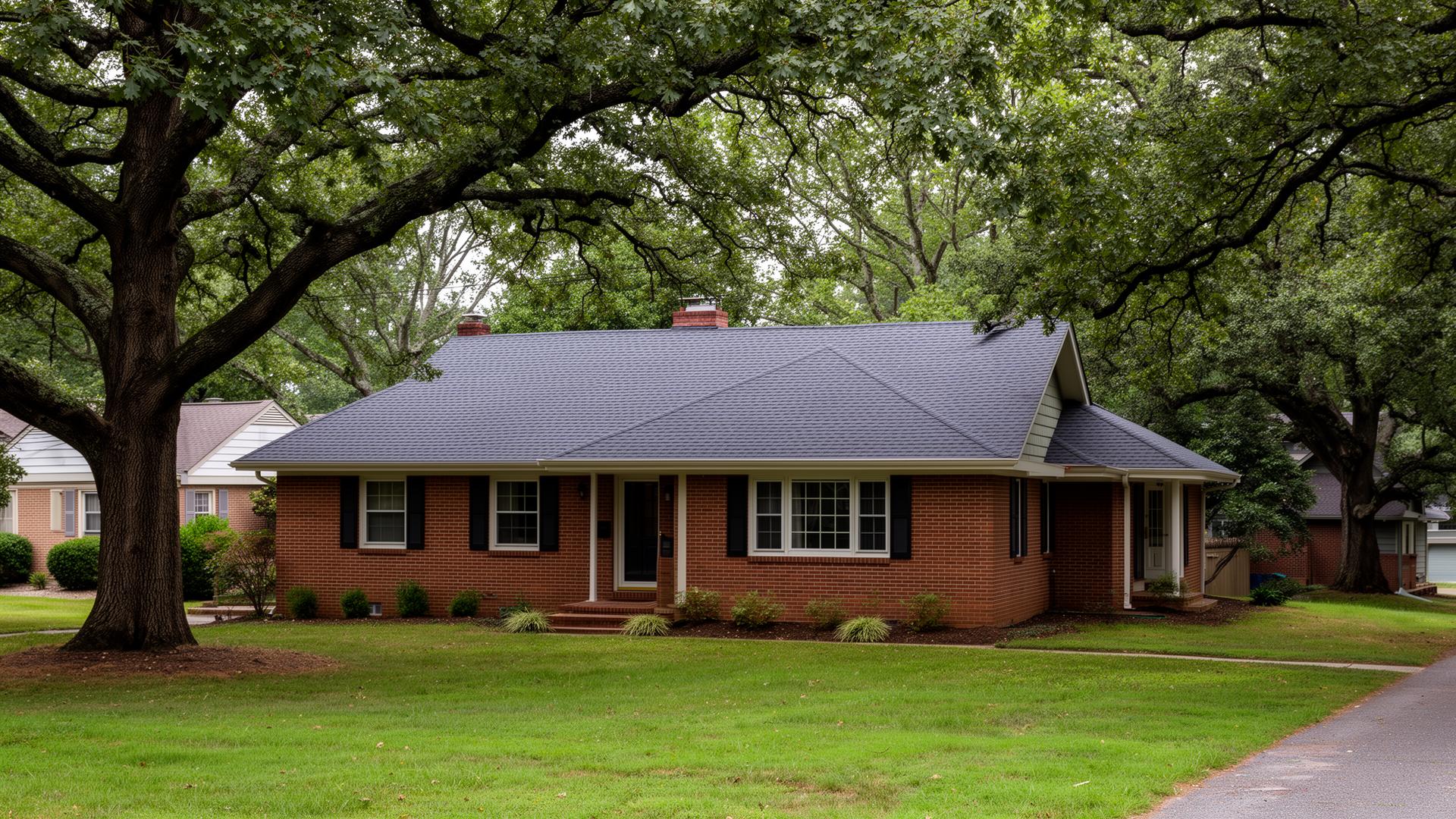
Silver Spring, MD
Roof replacement for Silver Spring's older, tree-canopied homes.
Most Silver Spring roofs sit under heavy canopy, on framing that predates modern ventilation standards, and on top of decades of small repairs. Here is how we plan an honest replacement on postwar capes, ramblers, and split-levels across Woodside, Forest Glen, Four Corners, Kemp Mill, and Indian Spring.
Why Silver Spring roofs age differently
Silver Spring is one of the most heavily wooded inside-the-Beltway markets in Maryland, and most of the housing stock was framed between the 1940s and 1970s. That combination is what really drives roof aging here. North-facing slopes in Woodside, Forest Glen, Four Corners, Kemp Mill, and Indian Spring stay damp for hours longer after rain than the same slope in an open neighborhood. Persistent moisture is exactly what gloeocapsa magma needs to grow, which is why algae streaking is so common across shaded Silver Spring slopes. Wet leaf litter from oak, tulip poplar, and maple canopy sits in valleys and slowly corrodes original flashing. Moss colonizes shaded ridges. Attic ventilation that was acceptable in 1958 rarely meets what a modern shingle warranty assumes today, and decades of added insulation quietly suffocated the attic from below. Add original plank decking, repeated patch repairs around the same chimneys and valleys, additions that tied new framing into old at exactly the flashing details that fail first, and freeze and thaw cycles each winter, and you have the real reason a by-the-square quote rarely captures what an older Silver Spring roof actually needs.
What we look for on an older Silver Spring roof
Algae streaking and moss
Dark vertical streaks on north slopes are gloeocapsa magma feeding on shingle limestone. Green moss on shaded ridges holds moisture against the cap. Both shorten useful life and signal where shade pressure is highest.
Aging flashing systems
Original step flashing on additions, chimney counter-flashing painted over decades ago, and rusted pipe boots are usually due for full replacement. We replace, not reuse, on older Silver Spring tear-offs.
Unbalanced attic ventilation
Adding insulation without adding intake is the quiet roof killer in Silver Spring. We check intake and exhaust ratio before quoting so the manufacturer warranty actually applies and the deck stops cooking from underneath.
Soft decking and old plank sheathing
Plank decking, undersized rafters, and soft spots near former leak points are common in central Silver Spring. We inspect deck condition and price any replacement up front rather than as a change order.
Repeated patch repair history
If the same chimney, valley, or skylight has been patched three times in five years, the issue is the system, not the patch. We document what was patched and why each repair did not hold.
Soffit, fascia, and pest entry
Squirrel and bird entry through aged soffit is one of the most common add-ons on Silver Spring tear-offs, especially on 1950s and 1960s stock. We replace damaged wood as itemized line items.
Woodside, Forest Glen, Four Corners, Kemp Mill, Indian Spring
Intake and exhaust ratio confirmed before quoting
Quoted as separate line items, never buried fees
Roof replacement planning for older Silver Spring homes
If your Silver Spring home was built before 1980, a few planning decisions before tear-off save real money and avoid scope surprises mid-project. Most of what matters here is about the system and the attic, not the shingle color.
Ventilation modernization
Most older Silver Spring attics need rebalanced intake and exhaust to meet what a modern shingle warranty assumes. Plan this into the project, not after it. An attic that cannot dry out shortens any new roof you put on top of it.
Aging decking and plank sheathing
Plank decking and 1950s to 1970s framing often have soft spots near chimneys, valleys, and former leak points. Budget a realistic allowance for deck replacement so you do not end up with a change-order conversation on tear-off day.
Layered roofing systems
If your current roof is a second layer over an original, full tear-off is usually required to inspect decking and properly install a modern underlayment package. Going over a third layer is not a real option on older Silver Spring framing.
Repeat repair history
Document every repair you can remember and where it was. Repeating leaks at the same chimney, valley, or skylight tell us where the real problem lives. See roof repair vs roof replacement for the honest break-even.
Moisture, ice dam, and attic airflow history
If you have seen ice dams, attic condensation, or stains on upstairs ceilings, ice and water shield coverage and ventilation work are not optional add-ons. They are the actual fix.
Insurance and roof-age notices
Carriers in Maryland increasingly review roofs once they pass 15 to 20 years. See insurance company requiring a new roof and signs you need a new roof before responding to a notice.
Preparing an older home for resale
If you may list within 24 months, a documented system warranty and transferable workmanship warranty are real listing assets, especially on a 60 or 70 year old home where buyers and inspectors look hard at the roof first.
Budgeting honestly for aging systems
Older homes need a small contingency for decking, flashing, or soffit work that only becomes visible on tear-off. Financing is available when replacement is the right call but the timing is tight.
Common roofing issues in older Silver Spring neighborhoods
These are the recurring patterns we see across older Silver Spring stock. None of them are unusual on a 50 or 70 year old home. They are simply what aging asphalt, original ventilation, and decades of canopy do over time.
Algae streaking in Woodside and Forest Glen
Mature canopy keeps north slopes damp and feeds gloeocapsa magma. By year 12 to 15 the streaking is visible from the street, and granule loss begins to accelerate behind it. Algae-resistant shingles solve it on the next roof.
Moss colonization on shaded ridges
Green moss on north-facing ridges in Kemp Mill and Indian Spring holds moisture against the shingle cap and lifts the edges over freeze and thaw cycles. Pressure-washing is not the answer. Replacement with proper ventilation is.
Aging flashing in Four Corners
Original step flashing on 1950s and 1960s additions, painted-over chimney counter-flashing, and rusted pipe boots are the most common leak sources on Four Corners tear-offs. We replace them as standard scope.
Soft decking near chimneys and valleys
Plank sheathing that absorbed years of slow leaks shows up as soft spots that you can feel underfoot on tear-off. We document and replace it. Skipping this is how the next roof leaks in the same place.
Original ridge and gable ventilation
Mid-century homes were often built with gable vents only or undersized ridge ventilation. Modern shingle warranties assume a balanced intake and exhaust ratio that simply is not there. This is correctable during a replacement and not after.
Improper attic airflow after insulation upgrades
Insulation was added at some point in most older Silver Spring homes. If intake was not added at the same time, the attic stopped breathing. The deck cooks in summer and condenses in winter, and the next shingle layer pays for it.
Moisture buildup and ice dam history
Indian Spring and Kemp Mill homes with poor attic airflow see recurring ice dams along low eaves. Ice and water shield coverage well past code minimum is the right answer, paired with the ventilation fix.
Layered roof systems on older stock
Second layers over original wood shingle or early asphalt are still found on older Silver Spring homes. They hide deck condition and overload framing. Full tear-off is the only honest way to plan a long-term replacement.
Repeated patch repairs over decades
Three or more documented patches around the same detail almost always mean the underlying flashing, decking, or ventilation was never corrected. The patch cycle restarts until the system is rebuilt.
What impacts roof replacement cost in Silver Spring
On older Silver Spring homes, square footage is rarely the biggest cost driver. The condition of what is underneath the shingles, and what it takes to install around a mature canopy, usually moves the number more than the roof size itself.
Ventilation corrections
Older Silver Spring attics often need intake or exhaust work before a manufacturer will honor a full system warranty. The work is real and worth doing once. It is also a meaningful line item, so it belongs in the written quote up front.
Flashing replacement
Step flashing, chimney counter-flashing, pipe boots, and skylight curbs on a 50 or 70 year old roof are almost always replaced rather than reused. Quoting around this is one of the most common ways a low bid hides scope.
Decking and plank sheathing repair
Soft spots near former leak points, plank sheathing with gaps, and prior water damage all add to the spec. We document what is replaced and why so the line item is not a mystery.
Moisture and ice dam remediation
Homes with documented ice dams or attic condensation need expanded ice and water shield coverage and a real ventilation fix. Skipping either is how the new roof develops the same problems as the old one.
Tree canopy and access logistics
Heavy canopy means careful crane and dumpster placement, slower tear-off, more lawn protection, and longer cleanup. On tight Silver Spring lots and on-street logistics, this shows up in the price.
Cleanup in mature neighborhoods
Multiple magnet sweeps for nails in shaded lawns, gutter cleaning of accumulated debris, and protecting mature plantings during tear-off are real labor. Honest quotes itemize the cleanup scope.
Roof complexity on older additions
Additions and rear pop-outs connect new framing to original framing at transitions where flashing detail matters most. Those joints take more time and better materials to do right.
Soffit, fascia, and pest entry repair
Aged soffit and fascia repair is one of the most common add-ons on Silver Spring tear-offs. We quote it as an itemized allowance so the number does not change mid-project.
Neighborhood considerations across Silver Spring
Woodside
Postwar capes and colonials with mature canopy. Algae streaking is visible on most north slopes by year 12. Ventilation balancing and decking inspection are standard scope here.
Forest Glen
Older single-family stock under heavy shade. Algae-resistant shingles solve a problem that has been quietly shortening shingle life for decades. Original flashing usually needs replacement.
Four Corners
Mixed 1950s and 1960s housing with original additions still on the roof. Step flashing at addition tie-ins and soffit repair are the most common add-on line items.
Kemp Mill
Heavy canopy on split-levels and ramblers. Moss on shaded ridges and ice dam history are both common. Ventilation correction is almost always part of the right scope.
Indian Spring
Brick ramblers and capes on tree-lined streets. Plank decking, aged ventilation, and occasional ice dam damage often need attention alongside the shingle replacement.
Wheaton and townhome blocks
Coordinated with adjacent owners on shared roof lines. HOA notified before scheduling so nobody is surprised by hammering on a shared wall.
What we usually recommend on older Silver Spring roofs
For most older Silver Spring homes under canopy, CertainTeed Landmark Pro with StreakFighter is the practical default. On storm-exposed slopes or insurance-driven replacements we also quote NorthGate.
CertainTeed Landmark Pro
StreakFighter algae resistance for the shaded slopes you actually have, paired with Max Def color depth that reads well on traditional Silver Spring architecture. The practical default for postwar homes under mature canopy.
CertainTeed NorthGate (SBS / Class 4)
SBS-modified asphalt with Class 4 impact resistance. Often qualifies for a Maryland homeowners insurance discount, and a sensible call on storm-exposed elevations and insurance-driven replacements on older stock.
Roofing systems we install in Silver Spring
We install architectural asphalt systems suited to older homes under canopy. Ventilation corrections, flashing replacement, and decking repair are quoted as separate, itemized line items.
Traditional asphalt
Landmark Pro
With StreakFighter
Algae-resistant granule for shaded slopes and Max Def color depth for traditional architecture. The practical default on postwar Silver Spring homes under mature canopy.
Premium asphalt
NorthGate
SBS / Class 4
Rubberized SBS asphalt with Class 4 impact resistance. Often qualifies for a Maryland homeowners insurance impact-resistance discount. A sensible call on storm-exposed slopes and insurance-driven replacements.
Ventilation and flashing scope
Itemized
Per-line price
Intake corrections, ridge ventilation, step and counter-flashing, pipe boots, and skylight curbs are quoted as separate line items, not buried inside a per-square average.
Decking and soffit repair
Allowance
Documented on site
Plank decking replacement, soft-spot repair, and soffit or fascia work are quoted with a realistic allowance and reconciled against what is actually replaced, with photos.
Questions Silver Spring homeowners commonly ask
Plain-language answers to the practical questions we hear most often on older Silver Spring estimates. If you want a written number against your actual roof, the [instant estimator](/instant-roof-estimate/start) is the fastest way.
Why do roofs in Silver Spring get algae streaks?
Mature canopy keeps north and west-facing slopes damp for hours after rain. That is the exact condition gloeocapsa magma needs to grow, and it feeds on the limestone filler in standard shingles. StreakFighter-treated shingles like Landmark Pro are the right answer for shaded Silver Spring lots.
Do mature trees shorten roof lifespan?
They can, in a few honest ways. Shade keeps shingles damp, wet leaf litter holds moisture in valleys, overhanging limbs scuff granules, and dropped acorns wear on ridge caps over time. The answer is not removing trees. It is choosing shingle products and flashing details that match the conditions.
Can older Silver Spring homes need ventilation upgrades?
Often yes. A lot of Silver Spring housing was built before modern attic ventilation standards, and decades of added insulation made the imbalance worse. We check intake and exhaust ratio before quoting, not after the shingles are on, because that is where most of the real lifespan gain comes from.
Why do some older roofs keep needing repairs?
Repeating leaks almost always trace back to original flashing that was patched rather than replaced, attic moisture the ventilation cannot move out, or soft decking that no surface repair can fix. Each patch buys time. None of them fix the underlying detail.
Can repeated patch repairs eventually make replacement more practical?
Often, yes. If you have paid for three or more leak repairs in the last five to seven years on the same detail, the cumulative cost is usually approaching what a full replacement with corrected ventilation and new flashing would have cost. The patch cycle simply restarts on whichever detail was not addressed.
How long do roofs last on older Silver Spring homes?
Shorter than the wrapper says, almost always for conditions reasons rather than product reasons. A 30-year shingle on a shaded, poorly ventilated 1955 rambler frequently shows real wear by year 18 to 22. Correcting ventilation during the next replacement is the single biggest lifespan move.
Silver Spring roof replacement, common questions
- How long do roofs usually last on older Silver Spring homes?
- Real-world lifespan on Silver Spring's postwar housing stock is shorter than the number printed on the shingle wrapper, and the reason is almost always the conditions, not the product. Heavy canopy in Woodside, Forest Glen, Kemp Mill, and Indian Spring keeps north slopes damp, original attic ventilation rarely meets what a modern shingle warranty assumes, and decades of small repairs leave compromised flashing in place. A standard 30-year architectural shingle installed in 1998 on a 1955 rambler frequently shows meaningful wear by year 18 to 22. That is not a defect. It is the cumulative effect of shade, moisture, and an attic that never fully dried out between weather events.
- Why do roofs in Silver Spring get algae streaks?
- Those dark vertical streaks on north and west-facing slopes are gloeocapsa magma, a hardy airborne algae that feeds on the limestone filler in asphalt shingles. It thrives in the long damp shade common across Woodside, Forest Glen, Kemp Mill, and Indian Spring, where mature canopy keeps slopes wet for hours after rain. It starts cosmetic and becomes structural by accelerating granule loss. On heavily shaded Silver Spring slopes we usually recommend an algae-resistant shingle such as CertainTeed Landmark Pro with StreakFighter.
- Can mature trees actually shorten a roof's lifespan?
- Yes, in a few specific ways. Shade keeps shingles damp and feeds algae growth. Wet leaf litter holds moisture in valleys and accelerates flashing corrosion. Overhanging limbs scuff granules in wind events. And dropped acorns and small limbs over years of storms do real wear on ridge caps. None of that means cutting trees down. It means choosing shingle products, valley flashing, and ventilation that are honest about Silver Spring conditions.
- Do older Silver Spring homes usually need ventilation upgrades during a roof replacement?
- Frequently, yes. A lot of Silver Spring housing in Woodside, Forest Glen, Four Corners, and parts of Indian Spring was framed in the 1940s through 1970s, with attic ventilation specs that do not meet what a modern shingle warranty assumes. Decades of added insulation usually made the imbalance worse. We measure intake and exhaust ratio before quoting so the manufacturer warranty actually applies, and we price any corrections up front rather than as a change order.
- Why do some older Silver Spring roofs keep needing repairs?
- Repeated repairs on the same roof almost always trace back to one of three causes: original flashing that was patched rather than replaced, attic moisture that the ventilation cannot move out, or soft decking that no surface repair can fix. Each new patch buys time, not a solution. At a certain point the cumulative repair spend approaches what a full replacement with corrected ventilation and new flashing would have cost, and the patch cycle simply restarts on whichever detail was not addressed last time.
- Can repeated patch repairs eventually make full replacement more practical?
- Often, yes. If you have paid for three or more leak repairs in the last five to seven years, especially around the same chimney, valley, or skylight, the underlying issue is usually the system, not the patch. Our [roof repair vs roof replacement](/learning-center/roof-repair-vs-roof-replacement) guide walks through how we think about the break-even point honestly, including when continued repair is genuinely the better call.
- Can attic ventilation really affect how long my roof lasts?
- Yes, more than most homeowners expect. An attic that cannot move moisture out cooks shingles from underneath in summer and traps condensation against the deck in winter. Both shorten shingle life and rot decking from below. Balanced intake and exhaust is one of the few changes during a roof replacement that meaningfully extends real-world lifespan, and on older Silver Spring stock it is almost always part of the right scope.
- Our insurance carrier sent a notice about our roof age. What are our options?
- Carrier roof notices in Maryland are increasingly common once a roof passes the 15 to 20 year mark, and Silver Spring's older stock sees this often. You usually have several paths, from a documented repair with photo evidence to a full replacement that resets the policy clock. Our honest guide on [what to do when an insurance company is requiring a new roof](/learning-center/insurance-company-requiring-new-roof) walks through the decision without scare tactics.
- Will you also repair soft decking, soffit, or fascia damage during the replacement?
- Yes. This is one of the most common scope items on Silver Spring tear-offs. Plank decking from the 1950s and 1960s often has soft spots near old chimneys, valleys, and former leak points, and aged soffit is a common squirrel and bird entry point. We replace damaged decking, fascia, and soffit and price it as itemized line items so you see exactly what was replaced and why.
- How much does roof replacement cost in Silver Spring, MD?
- Silver Spring roof replacements vary widely because so much of the housing stock is older and no two roofs share the exact same complexity, ventilation history, or decking condition. A 1955 brick rambler in Woodside is a different project from a 1970s split-level in Kemp Mill or a townhome block in Wheaton. Our [instant roof estimate](/instant-roof-estimate/start) returns a written price range against your specific measured roof so you can plan a real budget before scheduling anything in person.
Online estimates are the starting point, not the contract
What the online number gives you
An honest written price range so you can talk budget without sitting through a sales meeting. Real per-square material and labor, against a measured roof.
What the on-roof walk confirms
Framing condition, deck condition, existing flashing, ventilation balance, and any soffit or fascia repair. The verification flag is shown directly on your saved estimate page so there are no surprises.
See your Silver Spring roof from satellite. Get a real price range.
No salesperson at your door. No two-hour pitch. Enter your address and compare Landmark, Landmark Pro, and NorthGate side by side against your actual roof.
Related guides and nearby markets
- Signs you need a new roof
- Roof repair vs roof replacement
- When insurance is requiring a new roof
- Best roofing shingles for Maryland homes
- HOA roof replacement in Maryland
- How to get a roof quote without a sales presentation
- Roof financing options
- Get an instant roof estimate
- Bethesda, MD roof replacement
- Potomac, MD roof replacement
- Rockville, MD roof replacement
- Gaithersburg, MD roof replacement
- All Montgomery County service areas